
UTTIPEC News Info Data Guidance
Showing posts with label Eco- Mobility. Show all posts
Showing posts with label Eco- Mobility. Show all posts
April 11, 2013

April 10, 2013

April 9, 2013

January 14, 2013
Eyesores to city attractions: plans afoot to develop Delhi nullahs into eco-corridors
Author(s): Amandeep Kang
Date: Jan 11, 2013
Pilot project cleared to convert Barapullah drain into an eco-mobility corridor

The Barapulla drain as it looks now (above) and artist's impression of how it will look after the project gets implemented (Courtesy UTTIPEC)
The nullahs of Delhi were once irrigation drains that watered the orchards scattered all over the city. Today, they are eyesores because they carry the city's sewage and filth. But it is possible to turn them into a major city attraction by developing them as landscaped green corridors that can be accessed by cyclists and pedestrians. A plan proposed several years ago to transform 350 km of drains in Delhi into eco-corridors that will have water treatment zones and walking-cum-cycling tracks finally seems to be moving ahead.
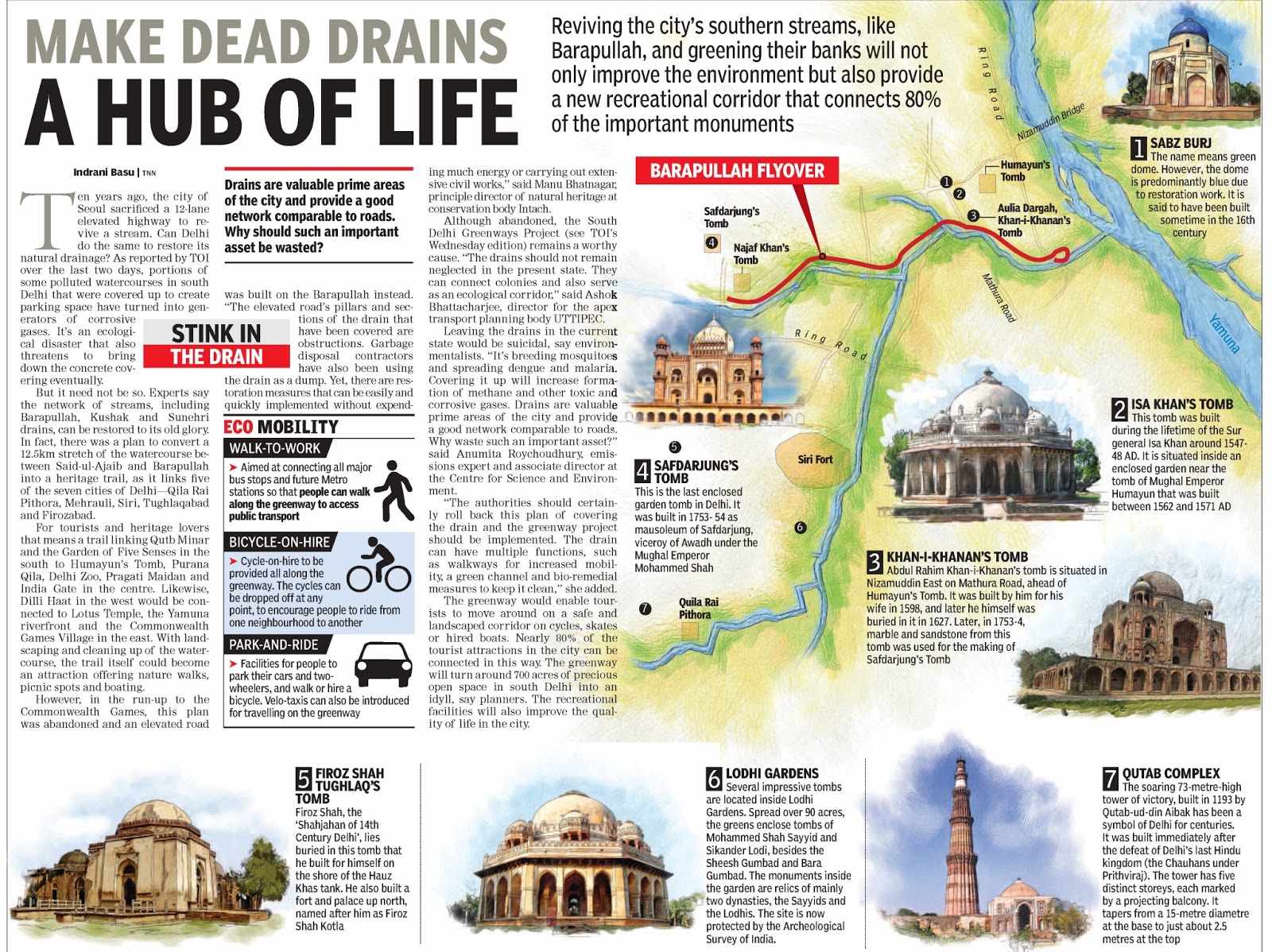
Recently, the Unified Traffic and Transportation Infrastructure (Planning and Engineering) Centre (UTTIPEC) cleared a pilot project—eco-mobility corridor or non-motorized public transport corridor—on either side of the Barapulla drain, costing an estimated Rs 16 crore. The nullah is one of the major drains of the city and connects major heritage zones of the city, including Humayun Tomb-Nizamuddin area and Mehrauli. The Jawaharlal Nehru stadium also falls in the way.
A quarter of the money for the project will be spent on treating the sewage in the drain, while the rest will be spent on cycle and pedestrian tracks. The tracks will be developed by raising both sides of the drain over a distance of 4.5 km. The idea is (as provided in the master plan) to ultimately convert all major drains of Delhi into green corridors to connect pedestrians and cyclists with metro stations and bus stops, using the linear connectivity offered by the natural drains of Delhi.
Director of UTTIPEC Ashok Bhattacharjee says the project will serve two purposes: it will improve water quality as well as reduce traffic congestion by providing cyclists and pedestrians safe passage. If successful, the project will be gradually extended to the other drains that criss-cross the city.
Major hurdle
The work has yet to begin owing to the multiplicity of agencies involved, such as Delhi Development Authority (DDA), Municipal Corporation of Delhi (MCD), Public Works Department and Delhi Jal Board. No date is set yet regarding the actual take off the project. Savita Bhandari, director (landscape) with DDA, says, “I am optimistic of its implementation in the near future.” One possible option could be the constitution of a governing body to ensure coordination among the involved agencies, says Bhattacharjee.
One of the aims of converting these drains into eco-corridors is to unlock the potential of this neglected drainage network and utilize it to establish walkways, pathways for cycling and to create green spaces. With this intention, in 2007 a master plan was prepared for south Delhi with Infrastructure Development Finance Company as lead consultant. Over 280 hectares of land is available around the drains that is not being utilised at present.
The proposal also includes treatment of the wastewater using alternate technologies such as bioremediation and constructed wetlands at the source level. Three government bodies, including DDA, MCD and Delhi and Delhi Tourism & Transport Department came together for its implementation. However, due to the high estimated cost (Rs 600 crore), the project could not be implemented.
The idea of a green corridor was first thought of in the late 1990’s when a group of women from Defence Colony Resident Welfare Association (Barapullah nullah passes through this posh south Delhi colony) felt that they must do something to keep the stinking storm water drain out of their sight. They decided that walls should be erected on both sides of the nullah. When Akash Hingorani, an architect who runs the Oasis Design Inc. came to know of this, he suggested a better solution.
“This (the walls) could have definitely kept the nullah out of the sight, but it would still be stinking and in fact could have created more problems both in terms of people using the walled area as a dumping ground, as well as a place for crime,” says Hingorani. He requested the Defence Colony RWA not to pursue this idea. He hit upon a more sustainable solution to get rid of the unpleasant sight of the nullah—develop the storm water drain into an eco-corridor.
Delhi’s natural drainage network is of 350 km in length. There are 19 major drains with over 15,000 sub-drains. The interesting part of this complex drainage network is that it provides a great opportunity to connect people and spaces to the current public transportation network. At present, these drains are a major issue of concern for Delhi as they perpetuate a number of environmental problems due the amount of untreated sewage that these drains carry. These drains carry more than 4,000 million litres a day of sewage, which is discharged into the Yamuna river, mostly untreated.
In 2009, Morphogenesis, another architecture firm also conducted similar research and made a similar proposal to the lieutenant governor’s secretariat; it aimed to utilise Delhi drains as an alternative cultural, environmental and transport network. However, it remains an ambitious idea given the level of planning and administrative coordination required among the government agencies and the stakeholders, particularly when considering its implementation throughout Delhi as per the master plan.
Source: www.downtoearth.org.in
October 28, 2012
OPEN DRAINS TO MAKE WAY FOR ECO CORRIDORS
Non-Motorized Transportation Project To Develop Areas Along Drains As Recreational Public Spaces & Special Corridors For Cycling And Walking
.jpg)
The non-motorized transportation (NMT) eco-corridor project will be incorporated into DDA’s master plan and has been prepared by UTTIPEC. The project has two components — developing areas along drains as recreational public spaces and developing a road network that includes special corridors for cycling and walking. “We have to shift focus from traffic planning to mobility planning. However, the development of recreational areas is entirely dependent on the cleaning of the drains. The project has been around for ages but if it has to work the government needs to take a holistic view of it and carry out all works together,” said an official.
The project aims to tackle open drains and bring down traffic congestion, which is the prime reason for Delhi’s rising pollution problems. “Among the proposals we have already mulled are connecting Nizamuddin Railway Station and ISBT to Jungpura Metro Station. The existing open drain behind Nizamuddin that passes by Jungpura is an ideal location to develop NMT. The other stretch is from Sheikh Sarai to Moolchand Metro station. This will also provide connectivity from the Saket malls to GK-I. The project along the Barapullah drain is the most extensive and will provide an interface with existing modes of public transport,” said UTTIPEC director Ashok Bhattacharjee. “We have a cycle sharing system along the BRT corridor but one reason it failed was the insufficient number of stations to park. Development of sufficient infrastructure is a priority. A sizeable number of cycle parking points, convenient hiring systems, accessible locations and dedicated paths even along the main roads need to be put in place. The cycle tracks need to become transit routes, between colonies, within colonies and between colonies and public transport points,” said a source.
The environment department, too, has been promoting the project. “By encouraging walking and cycling, we will be able to tackle congestion, bring down pollution, create open public spaces and deal with the problem of untreated sewage,” said an environment department official.
Source: Times of India (28 Oct 2012, pg 4)
‘Covering drains is a worse move’
.jpg)
New Delhi: DDA has been on a drain covering spree, but UTTIPEC says space utilization has been the worst. Instead, developing it aesthetically, treating the sewage and creating cycling and walking paths along the drains would be a much better approach.
“Covering drains opens up some space and covers up an eyesore, but a better utilization would actually happen if the sewage was treated. Once the drain is covered up, the civic agencies are likely to forget about the problem. Also, sewage undergoes natural treatment through sunlight and aeration in an open drain. Once it is covered, the chances of it raising a stink actually go up,” said UTTIPEC director Ashok Bhattacharjee.
UTTIPEC's Non-Motorized Transportation Eco Corridor plan says, “Concrete slab effectively stops groundwater recharge and the slab cover over the nullah shall aggravate the ‘heat island’ effect.” Water has a natural cooling effect on its surroundings: an advantage that will be lost during Delhi's searing summer.
The project also says desilting the drains once they are covered would become an expensive and cumbersome task. Such cleaning, it says, will “require super suction machines” since cranes etc would no longer be able to access the sewage. “The sewage shall be deprived of sunlight and oxygen, creating septic conditions, increase the river's pollution load,” it adds.
Officials suggest the sewage should be treated and the channel reused as a parkway. “Instead of making everything into a concrete jungle, the area could be developed as a green belt and a linking route for NMT users from one public transport point to another,” said a source.
The Defence Colony drain, on which work is still on, has left residents quite unhappy. “Since work on covering the drain has started, sewage has started backflowing in our bathrooms. The stench has also increased,” said AP Singh, a resident.
Implications of covering drains
- Environmentally bad decision as the problem gets 'out of sight out of mind' and situation worsens
- The concrete slab effectively stops groundwater recharge
- The slab cover over the nullah shall aggravate the ‘heat island’ effect
- The siltation in the drain shall become difficult and more expensive to manage and would require specialized super suction machines
- The sewage being carried by the drain shall be deprived of sunlight and oxygen, creating septic conditions and effectively increase the pollution load on the river.
Source: Times of India (28 Oct 2012, pg 4)
Subscribe to:
Posts (Atom)