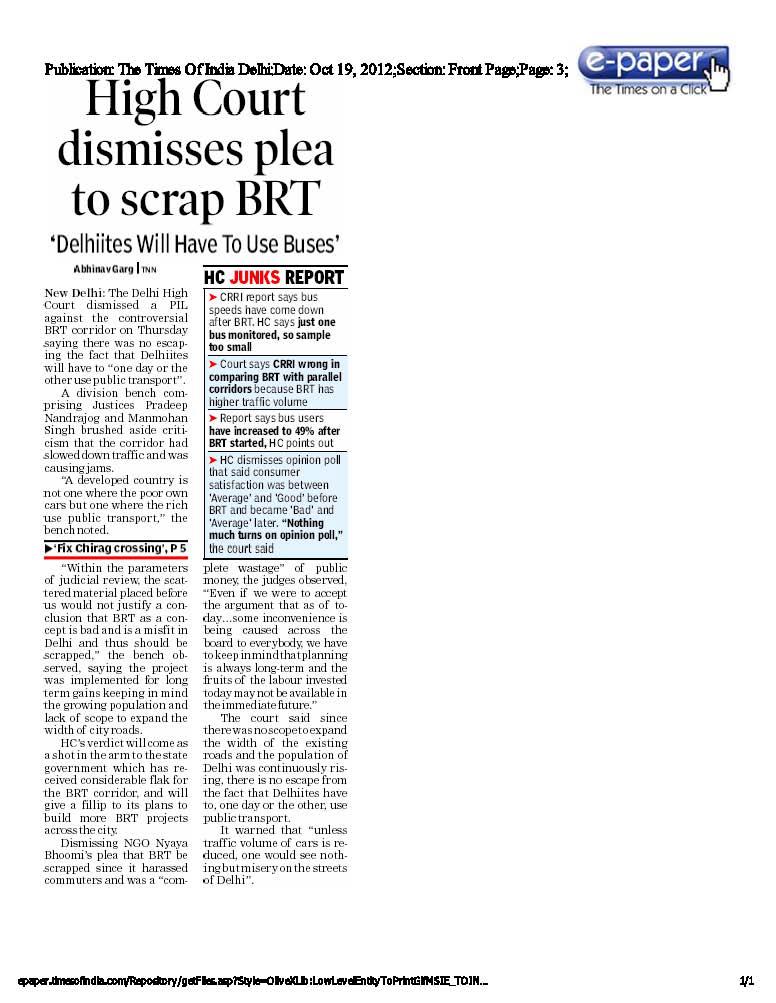
With the fate of Delhi's only bus rapid transit (BRT) corridor still hanging in the balance, Hazards Centre – a non-government organisation – came out in its support and demanded its proper implementation. The organisation was supported by IIT professors and transport experts Dinesh Mohan and Geetam Tiwari, who came out in defence of the corridor and called the Central Road Research Institute (CRRI) study biased. Mohan and Tiwari were on board when the Delhi government had planned, designed and executed the BRT corridor between Ambedkar Nagar and Moolchand Hospital. "The CRRI study did not take the views of bus users. The survey took views of 25% bus users, even though 66% people travelling on the corridor are actually bus users," said Tiwari. Hearing a public interest litigation, the Delhi High Court had asked the CRRI to carry out a study on the BRT corridor in May this year. Mohan said he was surprised to see that the CRRI, which had not been allowed to work on the BRT corridor by the ministry of urban development because it was not "competent enough to work on a public transport project," was asked by the high court to review the project. "Data shows that the existing BRT corridor is one of the safest roads for women, children and elderly people in Delhi. Only two accidents took place on the 5.8-km BRT stretch in 2010. Also, a large number of people living in the neighbouring areas come for a walk here," Mohan said. Trashing the report submitted by the CRRI to the High Court, the NGO claimed that the report was skewed and only highlighted the views and suggestions of car users. NGO director Dunu Roy said a parallel survey conducted by them clearly showed that almost 90% people who travelled on the corridor were happy with separate lane for buses and emergency vehicles. Tiwari said Delhi government should have actually extended the corridor further so more people could benefit from it.
Source: Hindustan Times, Delhi Edition (14.08.2012)Original Link
The Hindu: This photo taken on October 20, 2008 shows a picture of Bogota's Bus Rapid Transit System used during the presentation by Vijayawada Municipal Corporation officials.
Frequent gridlock, unbridled congestion and health hazards due to carbon dioxide emission are part of the urban nightmare. Spiralling fuel costs and limited space further add to the woes of Indian cities. It is slowly dawning on policymakers that improved public transport is the key to sorting out these problems. But the question they frequently ask is whether people would make the shift to public transport. A host of cities from Africa to Australia, led by Curitiba and Bogota, have convincingly demonstrated that a smart Bus Rapid Transit System (BRTS) can make a difference. The first BRTS, inaugurated in 1974 in Curitiba, Brazil, caught the world’s attention. The city managers boldly demarcated dedicated bus lanes on roads perceived as a privileged space for cars. These exclusive lanes improved speed and reduced travel time. Well-designed buses turned intra-city travel a pleasure. Intelligent integration of bus network and city planning reduced trip lengths.
In 2000, the city of Bogotá in Colombia improved upon the Curitiba model and launched its own TransMilenio BRTS. Its resounding success silenced the sceptics and reiterated that wise planning does deliver. Cities were enlightened, and more and more of them reinvented their bus transport system. Indian cities, where the usage of private cars still constitutes a small percentage, had a well-working bus transport in the past. But over the years, they overlooked modernisation and failed to make sufficient investments. Consequently, the quality of services deteriorated. Cities such as Chennai that need a fleet of about 8,000 buses run on half the strength. Delhi, which should have about 11,000 buses, has only 5,771. As a result, India offers a meagre 1.29 buses per thousand passengers, while other well-planned countries provide vastly more — Brazil has 10.3 buses per thousand. The gaping holes in Indian urban transport policy stand exposed. Seemingly, the government learnt its lessons, and re-thought its approach. It announced a new National Urban Transport Policy in 2006, under which cities must prioritise public transport and take measures to make it more attractive. It strongly recommended that lanes and corridors be reserved for public transport and non-motorised modes of travel. The working group on urban transport for the Twelfth Plan has also recommended an investment of more than Rs. 40,000 crore to augment bus transport over the next five years. It is in this context that cities such as Delhi and Ahmedabad chose to implement the BRTS.
A recent audit of the BRTS across the world by the Institute for Transportation and Development Policy (ITDP) showed that Ahmedabad scored 76 out of 100 points, while Delhi scored only 22 points. The best system in the world — Bogota’s TransMilenio — topped the list with 93 points. This is not a reflection on the usage of Delhi BRTS, but on the dilution of design parameters. Despite having only a truncated network, the Delhi system carries about 12,000 passengers an hour per direction — far more than cities such as Beijing. The lower and middle-income groups, starved of good transport facilities, found the BRTS a great service. But the minority car owners strongly felt that the road space belonged to them and tried to put a spoke in the city’s wheels. On the other hand, Ahmedabad’s BRTS, aptly named Janmarg — people’s path — made significant design improvements, developed a large network, provided comfortable stations and safe transfers. Undiluted public support helped it succeed, where Delhi failed.
The contrast in the tale of two cities — Delhi and Ahmedabad — shows that half-hearted measures to address critical urban issues will not deliver.
The HinduThis April 20, 2008 photo shows a scene at the Chirag Dilli crossing during the first trial run of the Bus Rapid Transit corridor in New Delhi.
Proponents of the BRTS say it is a much cheaper option than the Metro. But it needs a dedicated pathway and standardised infrastructure for optimal results. It must be given a chance to perform
After the success of the Delhi Metro Rail Project, the Delhi government asked IIT-Delhi and RITES in 2004 to design and implement the first Bus Rapid Transit (BRT) corridor in Delhi along a 5.8-km stretch from Ambedkar Nagar to Mool Chand. From the day it opened in 2008, though, it has faced protests, particularly from private vehicle users, because their travel time increased. Some media groups launched campaigns against the system, and with politicians joining the chorus, the government put on hold 14 similar projects. Things did not end there. Some citizens took the matter to the Delhi High Court. The Central Road Research Institute conducted a study at the instance of the court and noted: “No BRT option yields better benefits for this corridor with the given traffic conditions.” After experimental trials in May, it also said “allowing of other vehicles to ply on the earmarked lane for buses yielded better benefits for all the road-users [ than the] BRT solution.” Based on the CRRI report, the court directed in mid-July that all categories of vehicles be allowed to ply on the dedicated bus lanes. The government vowed to move the Supreme Court against the order, with which it did not comply. It has been issued a contempt notice, and has to reply by August 8. Government counsel K.T.S. Tulsi says: “The CRRI report is full of contradictions. In fact, it supports the continuation of BRT with its conclusion that 70 per cent of its users were moving faster and there was a 32 per cent increase in bus ridership.” Car owners, he adds, are the major protesting group. Chief Minister Sheila Dikshit has said BRT is “for the common man,” but it faces hurdles from “vested interests.” A big question mark now hangs over the present project, while uncertainty persists on the continuation of the system as a whole. S.N. Sahai, Managing Director and CEO of Delhi Multi-Modal Integrated Transit System (DIMTS) Limited, which manages the system, insists that BRT is important because it is impossible for road space to increase at the rate at which vehicles are being added. “Nearly 25 per cent of Delhi’s area is already covered with roads. In London and other cities, that area is about 15 per cent.” “The main advantage of BRT can be seen during rush hour as it gives preference to buses, which, on average, carry around 40 people, instead of cars or other private vehicles. A bus occupies the space of just about two cars and carries about 10 times as many people,” Mr. Sahai explains. DIMTS officials point out that BRT is a low-cost option, compared to the Metro. One km of BRT costs Rs. 15-20 crore, about 20 times less than Metro which costs around Rs. 300-400 crore a km. In Delhi, BRT carries around 12,400 passengers per hour per direction as against about 25,000 for Delhi Metro. But car owners see a vacant lane for buses and wonder why they cannot use it. There are other factors too. Planners earmarked a 4.5-metre space for pedestrians and cyclists, which is seen as underused, while providing motorised vehicle users 7.5 metres and bus lanes 3.3 metres on each carriageway. Learning from experience, DIMTS has proposed several modifications in six new BRT projects. “Fewer junctions to reduce stoppage and waiting time, grade separators to eliminate junctions and a special purpose vehicle to run dedicated buses at high frequency.