Search This Blog

Showing posts with label Environment. Show all posts

January 27, 2013

Rules on paper, city stays noisy


Pollution Board Has Five Monitoring Centres, Three In Quiet Localities


New Delhi:Some would say it is the quintessential Punjabi spirit while others argue it is a pan-Indian streak but what can’t be denied is that we are a very loud people. The National Green Tribunal has issued an order to curb noise pollution in the capital, execution of which is mandatory for Delhi Pollution Control Committee. However, though something like excessive honking is already a compoundable offence, officials say it is a challenge to implement this order. 
    Delhi has five noise monitoring stations, two are located deep inside educational campuses and one in a residential area. Only two, at Pragati Maidan and Central Pollution Control Board’s Karkardooma office, are close to traffic points. Sources say that for a city the size of Delhi, five instruments are not enough and only three effectively indicate actual noise pollution levels. Another five are in the pipeline but CPCB sources say installation will take at least six months. 
    “The ones at DTU, Dilshad Garden and NSIT normally record noise levels below the standard about 80% of the time. Noise levels at Pragati Maidan are usually higher than the standard while those at CPCB peak with traffic,” said a CPCB official. 
    Another system exists at IGI but in absence of standards for aircraft, maintaining the record is pointless. Residents of Vasant Kunj took the matter to court after the new 
runway opened which placed the colony right in the middle of aircraft path. 
    Central Road Research Institute carried out a study of noise levels in Delhi in 2012 and found that trucks are the biggest source of noise pollution. At most of the 100 places surveyed, the decibel range was between 78 and 83. This, said a CRRI scientist, is almost 16 times more than permissible level. 
    “The noisiest area surveyed was the marble market in Kirti Nagar where 125 decibels were recorded. Meena Ba
zar in Jama Masjid recorded a high of 102.8 decibels. Anand Vihar ISBT and the Sangam Vihar bus stop in south Delhi recorded 108 and 114 decibels, respectively,” said a 2011 report published by Centre for Science and Environment. 
    The NGT order addresses the problem of traffic, interstate vehicles and trucks and lists specific procedures for DPCC, Delhi Police, traffic police and transport department. Delhi government sources claim these are not easy to follow. “A fine of Rs 100 exists for excessive honking. 
We have been asking for it to be increased for several months. Even so, a honking culture exists in Delhi and it is impossible to take action against everyone,” said a traffic cop. 
    All of us who have ever travelled on Delhi’s roads have experienced this culture. The first horn is honked in the first millisecond of the red light turning green by the car standing sixth in line. Come wedding season and those who live around DDA parks can barely get any sleep. No loud music or loudspeakers are permitted between 10pm and 
6am but dancing into the night is the done thing. “Sometimes action is taken but that generally means the volume being lowered slightly,” Pratima Ghosh of Patparganj said. 
    The NGT order for the transport department and traffic police includes checking and prohibiting entry of heavy vehicles fitted with pressure horns in Delhi. “It’s wellintentioned but not very practical. The most practical of all orders is setting up a 24x7 call centre for complaints which will be done at the earliest,” a government source said.

Source: TOI (26 Jan, 2013) 

January 14, 2013

Eyesores to city attractions: plans afoot to develop Delhi nullahs into eco-corridors


Author(s): Amandeep Kang
Date: Jan 11, 2013

Pilot project cleared to convert Barapullah drain into an eco-mobility corridor


The Barapulla drain as it looks now (above) and artist's impression of how it will look after the project gets implemented (Courtesy UTTIPEC)


The nullahs of Delhi were once irrigation drains that watered the orchards scattered all over the city. Today, they are eyesores because they carry the city's sewage and filth. But it is possible to turn them into a major city attraction by developing them as landscaped green corridors that can be accessed by cyclists and pedestrians. A plan proposed several years ago to transform 350 km of drains in Delhi into eco-corridors that will have water treatment zones and walking-cum-cycling tracks finally seems to be moving ahead.
Recently, the Unified Traffic and Transportation Infrastructure (Planning and Engineering) Centre (UTTIPEC) cleared a pilot project—eco-mobility corridor or non-motorized public transport corridor—on either side of the Barapulla drain, costing an estimated Rs 16 crore. The nullah is one of the major drains of the city and connects major heritage zones of the city, including Humayun Tomb-Nizamuddin area and Mehrauli. The Jawaharlal Nehru stadium also falls in the way.
A quarter of the money for the project will be spent on treating the sewage in the drain, while the rest will be spent on cycle and pedestrian tracks. The tracks will be developed by raising both sides of the drain over a distance of 4.5 km. The idea is (as provided in the master plan) to ultimately convert all major drains of Delhi into green corridors to connect pedestrians and cyclists with metro stations and bus stops, using the linear connectivity offered by the natural drains of Delhi.
Director of UTTIPEC Ashok Bhattacharjee says the project will serve two purposes: it will improve water quality as well as reduce traffic congestion by providing cyclists and pedestrians safe passage. If successful, the project will be gradually extended to the other drains that criss-cross the city.
Major hurdle
The work has yet to begin owing to the multiplicity of agencies involved, such as Delhi Development Authority (DDA), Municipal Corporation of Delhi (MCD), Public Works Department and Delhi Jal Board. No date is set yet regarding the actual take off the project. Savita Bhandari, director (landscape) with DDA, says, “I am optimistic of its implementation in the near future.” One possible option could be the constitution of a governing body to ensure coordination among the involved agencies, says Bhattacharjee.
One of the aims of converting these drains into eco-corridors is to unlock the potential of this neglected drainage network and utilize it to establish walkways, pathways for cycling and to create green spaces. With this intention, in 2007 a master plan was prepared for south Delhi with Infrastructure Development Finance Company as lead consultant. Over 280 hectares of land is available around the drains that is not being utilised at present.
The proposal also includes treatment of the wastewater using alternate technologies such as bioremediation and constructed wetlands at the source level. Three government bodies, including DDA, MCD and Delhi and Delhi Tourism & Transport Department came together for its implementation. However, due to the high estimated cost (Rs 600 crore), the project could not be implemented.
The idea of a green corridor was first thought of in the late 1990’s when a group of women from Defence Colony Resident Welfare Association (Barapullah nullah passes through this posh south Delhi colony) felt that they must do something to keep the stinking storm water drain out of their sight. They decided that walls should be erected on both sides of the nullah. When Akash Hingorani, an architect who runs the Oasis Design Inc. came to know of this, he suggested a better solution.
“This (the walls) could have definitely kept the nullah out of the sight, but it would still be stinking and in fact could have created more problems both in terms of people using the walled area as a dumping ground, as well as a place for crime,” says Hingorani. He requested the Defence Colony RWA not to pursue this idea. He hit upon a more sustainable solution to get rid of the unpleasant sight of the nullah—develop the storm water drain into an eco-corridor.

Delhi’s natural drainage network is of 350 km in length. There are 19 major drains with over 15,000 sub-drains. The interesting part of this complex drainage network is that it provides a great opportunity to connect people and spaces to the current public transportation network. At present, these drains are a major issue of concern for Delhi as they perpetuate a number of environmental problems due the amount of untreated sewage that these drains carry. These drains carry more than 4,000 million litres a day of sewage, which is discharged into the Yamuna river, mostly untreated.
In 2009, Morphogenesis, another architecture firm also conducted similar research and made a similar proposal to the lieutenant governor’s secretariat; it aimed to utilise Delhi drains as an alternative cultural, environmental and transport network. However, it remains an ambitious idea given the level of planning and administrative coordination required among the government agencies and the stakeholders, particularly when considering its implementation throughout Delhi as per the master plan.

Source: www.downtoearth.org.in

December 28, 2012

New York Times - Untamed Motorization’ Wraps an Indian City in Smog

NEW DELHI JOURNAL
Altaf Qadri/Associated Press
The presidential palace was enveloped in smog on Nov. 3. New Delhi’s antipollution efforts have failed to keep up with growth. 
By NIHARIKA MANDHANA 
Published: December 26, 2012

NEW DELHI — When an acrid blanket of gray smog settled over India’s capital last month, environmentalists warned of health hazards, India’s Supreme Court promised action and state officials struggled to understand why the air had suddenly gone so bad.
The heavy smog has dissipated for the moment, but it has left behind a troubling reality for one of India’s most important cities: Despite measures to improve air quality, pollution is steadily worsening here, without any simple solutions in sight.
“This is like a ding-dong battle,” said Sheila Dikshit, the chief minister of the State of Delhi, moving her fingers like the flippers of a pinball machine. “We catch up with something; the pressures catch up more than that.”
Delhi, a growing metropolis of nearly 20 million people, has struggled to reconcile its rapid economic growth with environmental safeguards. Over a decade ago, the city introduced a host of policies that raised emission standards, closed polluting industries and expanded green spaces. It made a costly investment to convert the city’s buses and auto rickshaws to compressed natural gas. For a time, air quality visibly improved.
But those gains have been overwhelmed in recent years. “We have already plucked the low-hanging fruits, so to speak,” said Anumita Roychowdhury, the executive director of the Center for Science and Environment here. “Now it’s time for aggressive, second-generation reforms.”
Ms. Roychowdhury and other environmentalists say the government must now concentrate on slowing the rising number of vehicles on New Delhi’s roads. Each day, about 1,400 new vehicles hit the roads of the city, already home to over seven million registered vehicles, a 65 percent jump from 2003. As a result, fine-particle pollution has risen by 47 percent in the last decade. Nitrogen dioxide levels have increased by 57 percent.
Environmentalists recommend a hefty tax on diesel vehicles, a steep increase in parking charges and a rapid upgrade of the public transportation system to ensure more timely bus service and a better integration of buses and the metro rail system.
“These strategies can be implemented immediately and will have an immediate impact on the numbers of vehicles,” Ms. Roychowdhury said. “We have to stop this untamed motorization now.”
But government officials say that a mere crackdown on vehicles ignores other aspects of the problem. They note that New Delhi is landlocked and lacks the coastal breezes that flush polluted air out of other major Indian cities like Mumbai, Kolkata and Chennai. Ms. Dikshit said New Delhi’s rapidly growing population and prosperity add to the pollution.
“It’s an epicenter of trade, of commerce, of governance for this entire northern area,” she said. As a consequence, Delhi “bears a much bigger burden.”
Officials say much of the pollution comes from neighboring areas, where emissions standards are lower and environmental policies virtually nonexistent. For days after November’s smog spell, many Delhi officials responded by blaming a coincidence of factors, including agricultural burnings in the neighboring states of Punjab and Haryana and the impact of a cyclone off the southern coast.
Weather conditions played a role, environmentalists agree, but that is no excuse for ignoring the underlying problems.
“The government cannot say that the smog was solely because of bad weather,” saidMukesh Khare, a professor of environmental engineering at the Indian Institute of Technology in Delhi. “They are making excuses to avoid facing the fact that Delhi has a pollution problem once again.”
Until two years ago, environmentalists and city officials in New Delhi lacked monitoring equipment to determine air pollution levels, and scientists and policy makers were dependent on ad hoc surveys conducted manually or on data from the national pollution body that often were incomplete or arrived too late.
In 2010, the Delhi government posted six state-of-the-art monitoring machines around the capital that now constantly measure a host of pollutants, sending real-time data to a publicly accessible Web site.
“We didn’t really understand the situation before,” said Mohan George, a scientist at theDelhi Pollution Control Committee. “Now we have authentic, continuous and reliable data.”
In November, the machines recorded pollution levels at least six or seven times greater than the national standard for safe air. On Nov. 9, for instance, the levels of particulate matter called PM10 near the University of Delhi measured 908 micrograms per cubic meter, against the standard limit of 100, falling into the “very unhealthy” category.
The city’s doctors are worried. Dr. Randeep Guleria, who runs the pulmonary medicine department at the All India Institute of Medical Sciences, said the number of emergency visits relating to respiratory and heart problems had risen sharply this winter.
What is going on in New Delhi reflects a larger trend. A recent study published in the medical journal Lancet shows air pollution has become a major health risk in developing countries, contributing to about 3.2 million premature deaths worldwide. South Asian countries are particularly vulnerable, the study found.
The local government has commissioned a study to understand what exactly caused the smog, and is working on an “air action plan” that would expand the subway system, introduce a network of bike lanes and make the city’s roadways more friendly to pedestrians.
The Supreme Court, which has played the role of environmental watchdog in Delhi for more than a decade, has recommended a more politically delicate measure: imposing an “environment compensation charge” of 25 percent on new diesel vehicles and requiring a much smaller fee for existing gasoline- and diesel-powered cars.
Ms. Dikshit, Delhi’s chief minister, has agreed to consider such a “green tax” and welcomed other solutions, even as she denied that the city’s pollution was reaching alarming levels.
“What is alarming is the impact that Delhi’s prosperity and its comfortable living is having on attracting more and more people to come here,” Ms. Dikshit said. “How much we will be able to sustain that impact of people coming and never going out is a big question.”
A version of this article appeared in print on December 27, 2012, on page A10 of the New York edition with the headline: ‘Untamed Motorization’ Wraps an Indian City in Smog.

Source: http://www.nytimes.com/2012/12/27/world/asia/indian-city-overwhelmed-by-air-pollution-new-delhi-journal.html?ref=global-home&_r=0
December 25, 2012

Pollution level rising, govt turns a blind eye

Study finds three-fold increase in air pollution across world in 10 years; in Delhi, toxic elements rise by up to 57%.


The Centre for Science and Environment (CSE) has expressed "deep shock" at the findings of the new Global Burden of Disease (GBD) count. The findings say air pollution has become one of the top 10 killers in the world — a threefold increase in the last 10 years.

A CSE analysis says as much as 65 per cent of total air pollution deaths occur in Asia and close to quarter of this in India.

A global initiative involving the World Health Organisation (WHO), the GBD tracks deaths and illnesses from all causes across the world. Anumita Roychowdhury, CSE's executive director-research and advocacy and head of its air pollution unit, said: "We need aggressive and most stringent action to protect public health."

In Delhi, the level of particulate matter less than 10 micron in size (PM10) has increased by 47 per cent between 2000 and 2011, while the level of nitrogen dioxide has gone up by 57 per cent.

The level of particulate matter less than 2.5 micron in size (PM2.5) is also exceeding the standard by 4-6 times. “High levels of carbon monoxide, ozone and benzene levels are also playing havoc,” said Roychowdhury.

Despite all this, the Delhi government has not been quick in implementing immediate winter measures — part of a fiveyear plan to improve the Capital's air quality — which it had announced more than a month ago.

By now, the government should have put in place the immediate measures and submitted a status report.

Referring to the GBD data, Roychowdhury said: “Days of complacency are over. We must act urgently to reduce public health risks, especially for children, elderly and poor.”

The Delhi government and the CSE have prepared a 10 point draft action plan to meet the desired air quality in the Capital by 2017.

“We have discussed the 20-page draft and almost finalized it. After minor correction, this will go to the Cabinet for approval. The plan will be implemented soon,” said a senior government official.

November 27, 2012

Catfish signals revival of city lakes: Untreated Sewage A Problem


Untreated Sewage A Problem, But Hauz Khas & Neela Hauz Being Cleaned


New Delhi: The recent discovery of a 3.5 feet long catfish in the shallow Hauz Khas Lake had marked a major progression in the revival of the lake, which till some months back had been a smelly cesspool of untreated sewage. Though residents still complain of foul smell from a part of the lake but its biochemical oxygen demand — an indicator of pollution levels — has dropped from 11mg/l to 6 mg/l in a span of six months. 
    A few kilometres away, Neela Hauz continues to languish under an onslaught of untreated sewage. Both water bodies have the same source of water — treated effluent from the Vasant Kunj sewage treatment plant and untreated sewage from Mehrauli and nearby areas. Neela Hauz, over which a flyover was constructed for the Commonwealth Games and should have been restored by October 2010, is now
supposed to be restored by February next year as per a high court order. 
    Debris from the water body was just cleared last week and according to Delhi Development Authority officials, the water body will be restored by the court-set deadline. 
    Plantation will be carried out by next monsoon. While debris dumped by the PWD around the lake during the flyover construction has been removed, a lot of it that subsequently was dumped into the main water body is still to be cleaned out. 
    “The revival plans released by DDA show a much smaller area of the lake compared to what it was before the flyover project began. Our concern is not the peripheral work that DDA will get done on plantation etc. We only want that the water body is preserved properly, and for that untreated sewage must be stopped from entering it and secondly, the area of water should be increased,” said Nitya Jacob, a resi
dent of Vasant Kunj. 
    According to Delhi Jal Board officials, they will be trapping untreated sewage from the Kishangarh area in Mehrauli and diverting it to Vasant Kunj STP. Some institutions, located near the lake, have been discharging their waste into it directly and they have been asked to take corrective measures. 
    The lake will finally be merged with Sanjay Van where efforts by residents have already seen some improvement in water quality of the lake there. 
    From Neela Hauz to Hauz Khas Lake, there are five check dams where residents of nearby areas have introduced fish. These catfish have found their way to Hauz Khas and feed on the carps that were introduced in the lake. 
    The check dams also act as regulators since anytime the flow of untreated sewage increases, they can be shut down. 
    “The Hauz Khas Lake is fed by 
treated effluent from the Vasant Kunj STP, some untreated sewage from the Mehrauli ward and rainwater. The north/northeast side of the water body is deeper and in the shadow zone — meaning it is protected from sunlight and wind. Hence it also looks dirtier. Other than bio-remediation, we have asked DDA to take water from the deep end for gardening, ensure that the pipe from the last check dam to the lake should always have water flowing through it and ensure that aerators work at the deep end,” said Manu Bhatnagar, the principal advisor of environment projects in Intach’s natural heritage division. 
    “We have seen a substantial change in water quality in the past few months,” he added. Intach is working in an advisory capacity with DDA to revive the lake. 
    The lake has started receiving migratory birds as well, but sources say that DDA officials are not following all 
instructions and untreated sewage often finds its way into the lake. 
    “The aerators are also not working and the part of the lake next to the monument is filthy and smelly,” said Rashmi Singh of Green Park.
Source: TOI (pg.9, 25 Nov 2012)

November 23, 2012

Yamuna - Capital’s lifeline is now no more than a sewer

Thirty years ago, Delhiites would go to the banks of Yamuna for leisure — swimming, boating, bird watching. Today, the river is no more than a huge open sewer.
The Capital’s lifeline is now no more than a sewer "There were lots of winter birds. There was this private, cordonedoff area with a number of donkeys carrying sand. They were called gadhewale," recalled Rakshanda Jalil, author and heritage lover, as she got nostalgic about her annual childhood family picnics to the Yamuna bank in the early 1970s.
From Nizamuddin (East), her family would drive up to Okhla. "It used to be a day-long adventure. It was a clean, open area with mostly farming activity. On this huge mound of sand, we would go up and come rolling down," she said.
Most Delhiites born after 1970s, or migrants who came later, will find it hard to believe but the Yamuna waterfront was once a place to visit. Swimming, fishing and farming were regular activities.
Dangals (traditional wrestling), kite flying and even boating activities were also prevalent till the 1970s. Sailing and yachting happened too. But as the population grew exponentially, the pressure on the river and its resources increased.
The river was already bearing the load of untreated sewage. And over the years, the authorities completely stopped the flow of fresh water beyond Wazirabad; all the water is diverted from here for drinking purposes. What remains downstream of Wazirabad now is a channel of untreated sewage.
As if that was not enough, the flood plains, which are vital for the recharge of ground water, have been encroached Delhi boasted of over 1,000 water bodies once. Over the years, ‘development’ and pressures of population have spelt disaster for them. upon. One of the culprits is government agencies. (See graphic).
"A river is called so when it has aviral (continuous flow) and nirmal (clean water) flow. Aviral is sine qua non for nirmal," said Manoj Misra of Yamuna Jiye Abhiyan.
The Yamuna today is neither 'continuous' because there is no water left after being diverted for potable use —the city's own quota of water as per the inter- state water sharing act — nor it is 'clean' what with more than a dozen nullahs releasing untreated sewage into it.
Rishi Dev, an architect and an ekistician (holistic planner), said, "While pollution is one of prime factors for Yamuna's death, the other factors are ignorance towards a larger river system network, water carriage system of sewage disposal and improper planning of barrages and drains."
"A biodiversity zone can be created along the major drains so most of the waste is self-cleaned. Revenue too can be generated from these biodiversity zones to maintain the river systems. The hydrology of the Yamuna, which extends up to these drains, should be preserved under the same programme," he says.
Dev also suggested, "Delhi should follow a mixed system of sewage disposal — a combination of the conventional water carriage system where water is used to carry sewage quickly for disposal and the conservancy system of sanitation where sewage or garbage is collected and disposed of separately. Up to the neighbourhood, it should follow the water carriage system, after which it should be converted to the conservancy system."

Misra said, "Time is ripe for change. The existing agreement of 1994 is immoral. It should be revisited and renegotiated. In that process, first allotment should be for the river."


Source: HT (Pg 4, 21 Nov 2012)

November 5, 2012

October 28, 2012

HC: Civic Agencies Told to Ensure Untreated Sewage Is Not Dumped Into Lakes

HC relief for Delhi's water bodies: Civic Agencies Told to Ensure Untreated Sewage Is Not Dumped Into Lakes

NEW DELHI: A recent Delhi high court order has spelt major relief for hundreds of water bodies in the capital that are being fed with untreated sewage. The court has directed Delhi Jal Board and Delhi Pollution Control Committee to ensure that unless sewage is treated to levels prescribed by the Central Pollution Control Board, it cannot be discharged into lakes, ponds or other water bodies.


Even as several lakes are fed by treated or untreated sewage — including Hauz Khas lake, Bhalswa lake and Sanjay jheel — DJB officials claimed that "to avoid pollution of ground water and harm to plants, animals and aqua life, it is not advisable to recharge ground water or water bodies with treated sewage because of the standards maintained of (at) the sewage treatment plants (STPs)".

"Biochemical Oxygen Demand or BoD levels in treated sewage should not be more than 30mg/lt. This is the level maintained at all STPs and most of them are treating this level too. However, against a demand of 680 million gallons per day, Delhi has sewage treatment capacity of 513.4 million gallons per day. It is treating even less as all sewage does not reach the STPs. A lot of this feeds small lakes and ponds. DJB's logic is that in flowing water systems like rivers, natural processes lead to an improvement of water quality. These systems are missing in still water systems," said a source.

The order, issued by Justice Rajiv Sahai Endlaw, has directed DPCC to monitor from time to time all STPs to ensure their proper functioning, and that any deficiency should be reported to DJB immediately.

DJB has also been directed to act immediately if DPCC complains about the working of any STP.

Both DPCC and DJB have been asked to ensure that treated sewage from STPs "is not discharged into water bodies like lakes, ponds etc, unless the same is compliant with prescribed standards".

The water quality in Hauz Khas has recently shown an improvement after DDA put up a check dam in Sanjay Van at the point where untreated sewage was getting mixed with Vasant Kunj's treated effluent and was entering the lake. However, the measure is only temporary and the lake could be at risk if the procedure is discontinued.

Bhalswa and Sanjay lakes are other examples of water bodies where untreated sewage finds its way into. While some may dry up if untreated sewage is stopped from flowing into them, sources say that sewage needs to be treated and not stopped from entering water bodies.

Source: Times of India (28 Oct 2012, Pg 6)

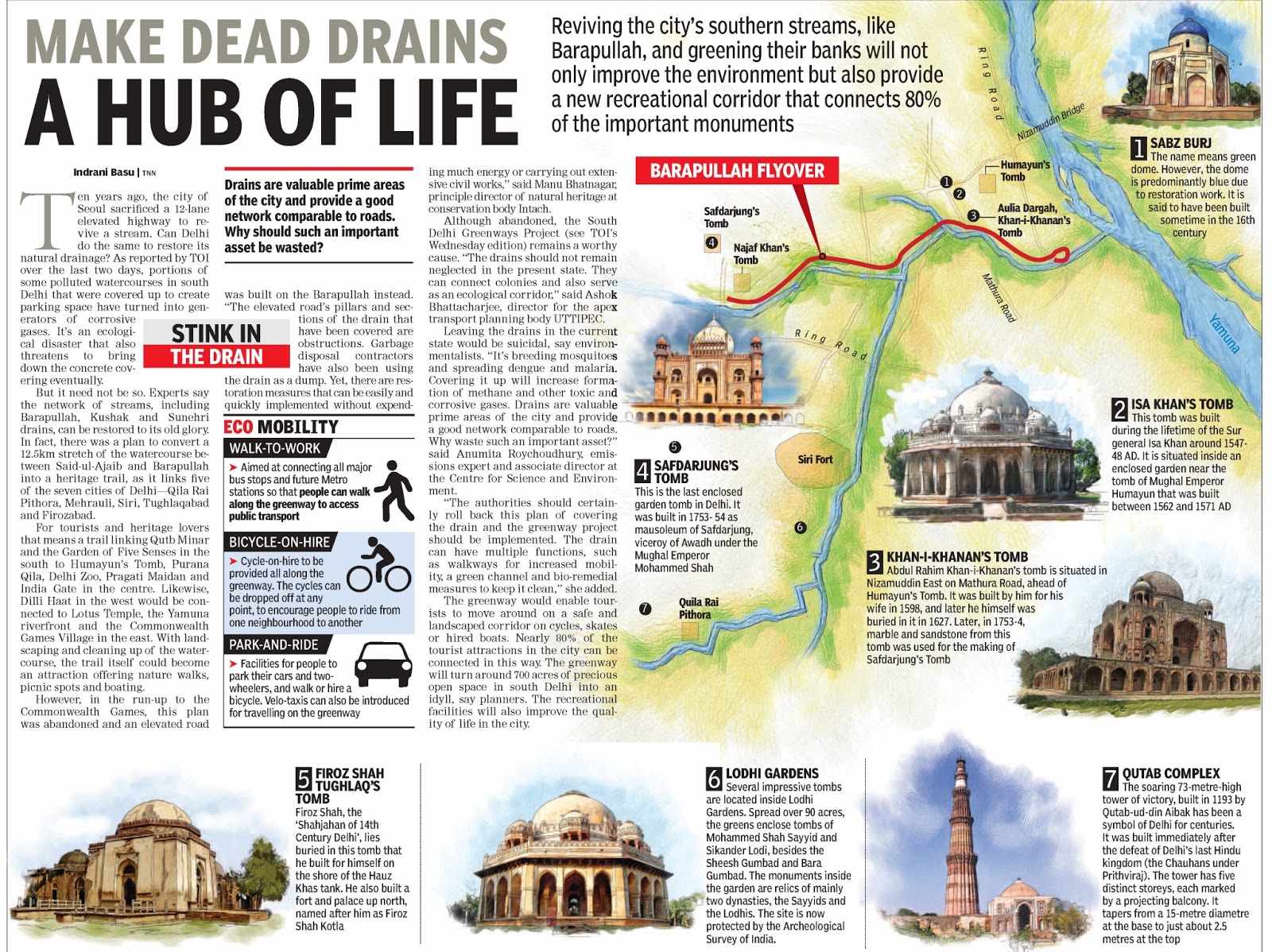
OPEN DRAINS TO MAKE WAY FOR ECO CORRIDORS

Non-Motorized Transportation Project To Develop Areas Along Drains As Recreational Public Spaces & Special Corridors For Cycling And Walking


New Delhi: Think of the drain behind your house, the eyesore of the colony which is usually lined with garbage, stray cattle and dogs, and stinks so much that one would not venture near it. Now imagine a tree- lined canal, an open public space that has people walking and cycling along the gently gushing water. The idea may sound ambitious but the Delhi government has plans to convert several of the city’s larger drains into eco-corridors: areas that will be used extensively as non-motorized stretches and connect colonies to the BRT corridor, Metro stations and bus stops. 
    The non-motorized transportation (NMT) eco-corridor project will be incorporated into DDA’s master plan and has been pre
pared by UTTIPEC. The project has two components — developing areas along drains as recreational public spaces and developing a road network that includes special corridors for cycling and walking. “We have to shift focus from traffic planning to mobility planning. However, the development of recreational areas is entirely dependent on the cleaning of the drains. The project has been around for ages but if it has to work the government needs to take a holistic view of it and carry out all works together,” said an official. 
    The project aims to tackle open drains and bring down traffic congestion, which is the prime reason for Delhi’s rising pollution problems. “Among the proposals we have already mulled are connecting Nizamuddin Railway Station and ISBT to Jungpura Metro Sta
tion. The existing open drain behind Nizamuddin that passes by Jungpura is an ideal location to develop NMT. The other stretch is from Sheikh Sarai to Moolchand Metro station. This will also provide connectivity from the Saket malls to GK-I. The project along the Barapullah drain is the most extensive and will provide an interface with existing modes of public transport,” said UTTIPEC director Ashok Bhattacharjee. “We have a cycle sharing system along the BRT corridor but one reason it failed was the insufficient number of stations to park. Development of sufficient infrastructure is a priority. A sizeable number of cycle parking points, convenient hiring systems, accessible locations and dedicated paths even along the main roads need to be put in place. The cycle tracks need to become transit routes, between colonies, within colonies and between colonies and public transport points,” said a source. 
    The environment department, too, has been promoting the project. “By encouraging walking and cycling, we will be able to tackle congestion, bring down pollution, create open public spaces and deal with the problem of untreated sewage,” said an environment department official. 

Source: Times of India (28 Oct 2012, pg 4)

‘Covering drains is a worse move’


New Delhi: DDA has been on a drain covering spree, but UTTIPEC says space utilization has been the worst. Instead, developing it aesthetically, treating the sewage and creating cycling and walking paths along the drains would be a much better approach. 
    “Covering drains opens up some space and covers up an eyesore, but a better utilization would actually happen if the sewage was treated. Once the drain is covered up, the civic agencies are likely to forget about the problem. Also, sewage undergoes natural treatment through sunlight and aeration in an open drain. Once it is covered, the chances of it raising a stink actually go up,” said UTTIPEC director Ashok Bhattacharjee. 
    UTTIPEC's Non-Motorized Transportation Eco Corridor plan says, “Concrete slab effectively stops groundwater recharge and the slab cover over the nullah shall aggravate the ‘heat island’ effect.” Water has a natural cooling effect on its surroundings: an advantage that will be lost during Delhi's searing summer. 
    The project also says desilting the drains once they are covered would become an expensive and cumbersome task. Such cleaning, it says, will “require super suction machines” since cranes etc would no longer be able to access the sewage. “The sewage shall be deprived of sunlight and oxygen, creating septic conditions, increase the river's pollution load,” it adds. 
    Officials suggest the sew
age should be treated and the channel reused as a parkway. “Instead of making everything into a concrete jungle, the area could be developed as a green belt and a linking route for NMT users from one public transport point to another,” said a source. 
    The Defence Colony drain, on which work is still on, has left residents quite unhappy. “Since work on covering the drain has started, sewage has started backflowing in our bathrooms. The stench has also increased,” said AP Singh, a resident. 


Implications of covering drains 

  • Environmentally bad decision as the problem gets 'out of sight out of mind' and situation worsens 
  • The concrete slab effectively stops groundwater recharge 
  • The slab cover over the nullah shall aggravate the ‘heat island’ effect 
  • The siltation in the drain shall become difficult and more expensive to manage and would require specialized super suction machines 
  • The sewage being carried by the drain shall be deprived of sunlight and oxygen, creating septic conditions and effectively increase the pollution load on the river.
Source: Times of India (28 Oct 2012, pg 4)